

7 Steps to Verify Contractor Insurance and Bonding
Last Updated: November 22, 2026
Quick Summary
To verify contractor insurance and bonding, ask the contractor's insurance agent to send a current certificate of insurance directly, then call the carrier to confirm the policy is active and the named insured matches the contract. Separately confirm the bond with the surety company and check the license with your state licensing board.
- Ask for documents to be sent by the contractor's insurance agent, not the contractor.
- Confirm the policy with the carrier using the phone number printed on the certificate.
- An additional insured endorsement is a separate document from the certificate.
- Confirm bond status with the surety company, not the contractor.
- Bond claim amounts are capped at the bond amount, so a bond supplements insurance.
Table of Contents
- Why Verifying Contractor Insurance and Bonding Protects Your Home
- How to Ask a Contractor for Insurance Before You Sign
- Reading a Certificate of Insurance for Contractors
- How to Validate a COI Directly With the Insurance Carrier
- How to Check if a Contractor Is Licensed and Insured Online
- Contractor Bond Verification: Checking Bond Status and Documentation
- What to Do When Verification Fails or Coverage Lapses
- Request a Quote From a Licensed and Insured Georgia Remodeler
- Frequently Asked Questions
Why Verifying Contractor Insurance and Bonding Protects Your Home
Verifying contractor insurance and bonding means confirming, through documents and independent sources, that the company working on your home carries active coverage and a valid bond. It is the single most important check you can run before signing a renovation contract.
Most homeowners never do it. They read a quote, check a reference or two, and hand over a deposit. That is how people end up paying twice for the same kitchen.
The stakes are simple and they are financial. If an uninsured worker is injured on your property, you can be pulled into the claim.
Below is a step-by-step process for verifying a contractor's insurance and bonding, arranged in the order that catches problems fastest.
How to Ask a Contractor for Insurance Before You Sign
Ask in writing, before any contract is signed, and ask for the documents to be sent directly by the contractor's insurance agent rather than by the contractor. That one detail filters out most problems.
Here is a request script you can copy and send:
"Before we move forward, please have your insurance agent email me a current certificate of insurance naming the policyholder as [contractor's legal business name]. I also need your license number, your bond information, and confirmation that any subcontractors will carry their own coverage. Please include the agent's contact details so I can confirm directly."
A legitimate contractor will not blink at this. A common mistake is accepting a photo of a certificate texted from a phone, screenshots are easy to alter and easy to misread.
Watch out: if a contractor gets defensive, says "we're fully covered, don't worry about it," or promises paperwork after the deposit, treat that as your answer. The refusal is the information.
For a broader walkthrough of vetting and hiring a renovation contractor, including what to check beyond insurance, see our guide on tips for hiring a renovation contractor.
Reading a Certificate of Insurance for Contractors
A certificate of insurance for contractors is a one-page summary issued by the insurer or agent. It proves a policy exists, but it is not the policy itself. Read it as a checklist, not a formality.
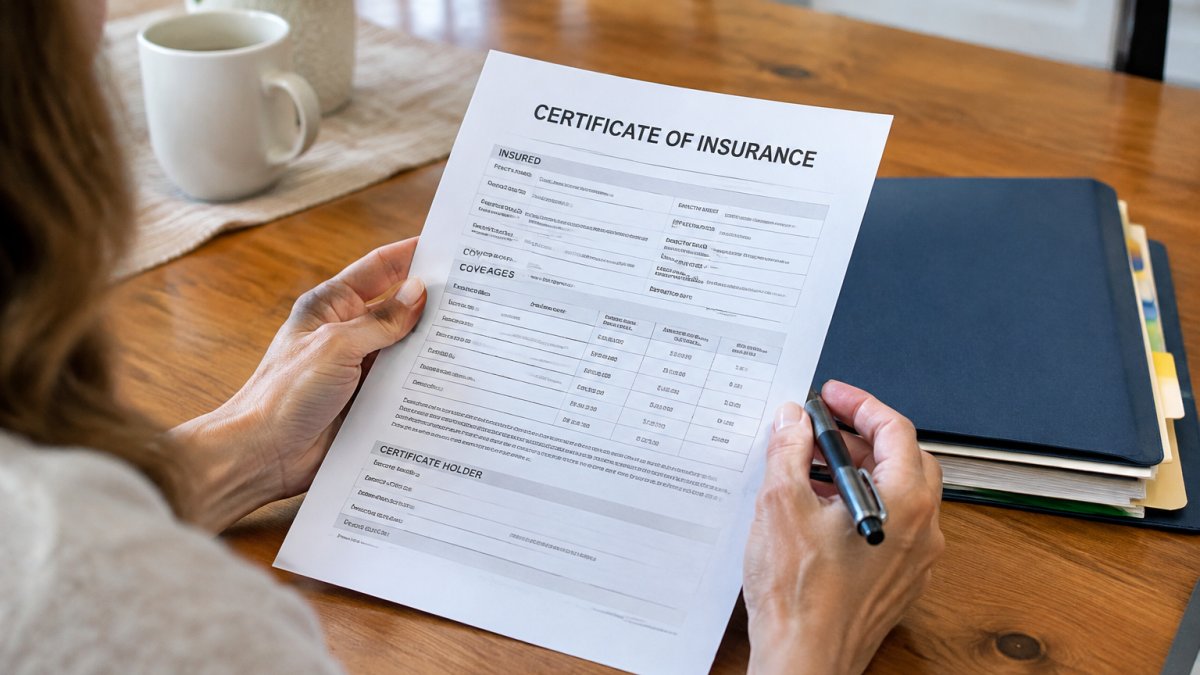
A certificate alone never confirms active coverage; it is a starting point for independent verification, not the finish line.
Check these fields, in this order, and treat each one as a question to answer rather than a box to tick:
- Named insured. It must match the contractor's legal business name exactly as it appears on the license and the contract, not a trade name, not an individual's personal name, and not a parent company unless the contract names that entity. A certificate issued to "J. Smith" when your contract is with "Smith Renovations LLC" is a mismatch worth stopping for.
- Policy number and carrier. Note both. You will need them to confirm coverage with the carrier. A policy number that the carrier cannot locate is the single most common sign of a forged or outdated certificate.
- Effective date and expiration date. Coverage must be active on the day work starts and last through the project. A policy expiring in three weeks is a renewal risk you should plan around before signing.
- General liability limits. This covers third-party injury and property damage. Note whether the limit is per occurrence or aggregate, and whether the policy is written on an occurrence or claims-made basis. Note whether the policy is written on an occurrence or claims-made basis, as the difference affects which claims are covered.
- Workers' compensation. Required in most states once a business has employees. If the section is blank or shows "excluded," ask why in writing. A sole proprietor with no employees may legitimately be exempt, but a crew of employees is not.
- Agent name and phone number. Your route to independent confirmation. Use the number printed on the certificate, not one the contractor texts you.
One gap trips people up constantly: a certificate can list general liability while the workers' compensation section is blank. If the crew is made up of employees rather than bona fide subcontractors, that blank matters.
Coverage Limits Matched to Your Project Risk
Match the limit to what you are building, not to the cheapest number on the page.
Higher-value projects, and anything involving excavation, roofing, or work near property lines, call for careful review of general liability limits. Ask what limit the contractor carries and whether it is per occurrence or aggregate, and confirm the limit is appropriate for the scope of your project.
Additional Insured Status and Project-Specific Coverage
Ask whether you can be named as an additional insured on the contractor's general liability policy for the duration of your project. Additional insured status gives you direct protection under their policy if a claim arises from the work.
For larger or higher-risk projects, request additional insured status in writing before signing. The key detail competitors often skip: an additional insured endorsement is a separate document from the certificate. Ask the agent to send the endorsement itself and confirm it names you and your property address, a certificate listing you as certificate holder is not the same thing.
How to Validate a COI Directly With the Insurance Carrier
Call the insurance agent listed on the certificate and confirm the policy exists, is active, and matches the limits shown. This step takes about ten minutes and defeats nearly every forged or expired document.
Use the contact details printed on the certificate, not a number the contractor gives you verbally. Then ask four questions:
- Is this policy active today?
- What are the general liability limits?
- Does it include workers' compensation coverage?
- Is the named insured exactly as shown on the certificate?
If the agent cannot confirm the policy, stop. A certificate that does not survive a phone call is not proof of anything.
How to Check if a Contractor Is Licensed and Insured Online
Use this sequence, and keep a written record of each result with the date you checked.
Step 1, License lookup first. Search your state licensing board database by license number and by the contractor's legal business name.
Step 2, Business identity second. Run the same legal name through the Secretary of State business search.
Step 4, Permit history fourth. Check the county or city permit department to see whether permits are pulled in the company's name.
Step 5, Complaint records last. Check the state contractor licensing agency's complaint and disciplinary records. Run this check after the others have narrowed your list.
Official places to look:
Confirm the legal business name matches what appears on your contract. A mismatch between the name on the quote and the name on the license is a red flag worth asking about.
Watch out: if the license lookup returns a name that differs from the certificate of insurance by even a word, "Smith Renovations" versus "Smith Renovation Services", do not assume it is a typo.
For a side-by-side look at how to vet competing builders, our breakdown of how to vet local contractors walks through the comparison.
Contractor Bond Verification: Checking Bond Status and Documentation
Contractor bond verification means confirming with the surety company, not the contractor, that a bond is active and covers the current license period. Ask for the bond number, the surety's name, and the bond amount, then call the surety to confirm status.
Bond documentation generally includes the bond number, surety company, bond amount, and effective and expiration dates.
A bond is not a maintenance or workmanship guarantee, and bond claim amounts are capped at the bond amount, so a bond supplements insurance rather than replacing it.
Insurance vs. Surety Bonds: What Each One Covers
| Feature | Insurance | Surety Bond |
|---|---|---|
| Who it protects | The contractor and third parties | The homeowner or obligee |
| What it covers | Injury, property damage, workers' comp | Non-performance, license violations |
| Who pays for claims | The insurer | The surety, which seeks repayment from the contractor |
| Typical payout cap | Policy limits | Bond amount |
| Who issues it | Insurance carrier | Surety company |
What to Do When Verification Fails or Coverage Lapses
Stop the project and put everything in writing. A failed verification is not a negotiation problem, it is a decision point.
Work through this sequence:
- Ask the contractor for a current certificate from the agent, in writing
- Call the carrier again to confirm the new document
- Check whether the lapse is a renewal gap or a canceled policy
- Hold any deposit until coverage is confirmed active
- If coverage cannot be produced, pause the contract and review your termination terms
If a quote also looks unusually low compared to others you received, the two problems are often connected. Our explanation of why renovation quotes vary so much covers the common causes.
Before you sign anything, review our checklist of what to look for in renovation contracts. Insurance terms and cancellation rights belong in that document.
Request a Quote From a Licensed and Insured Georgia Remodeler
Verification is not distrust. It is a reasonable step in protecting a large investment.
Exterior & Interior Solutions has completed more than 700 projects over two decades of residential renovation work, handling kitchen and bathroom remodels, whole-home builds, siding, and outdoor living spaces, with finishes from rental-grade to high-end luxury.
Get started with Exterior & Interior Solutions and request a quote.
Frequently Asked Questions
Do contractors need to be bonded and insured?
General liability insurance is a practical expectation for a legitimate contractor, and licensing requirements vary, so confirm what your state licensing board requires. Bonding requirements vary by state and by project type. Some states mandate a surety bond for certain license classes or for contractors working on public projects. Always confirm what your state licensing board requires for the specific trade and project you are hiring for, and ask for documentation rather than taking a verbal assurance.
How do I verify a contractor's general liability insurance?
Ask the contractor for a certificate of insurance naming their legal business name and policy number. Then call the insurance carrier or agent listed on the COI using a phone number you look up independently, not one printed on the certificate. Confirm the policy is active, the effective and expiration dates, the general liability coverage limits, and whether workers' compensation is included. A COI is a summary, not proof, so carrier confirmation is the step that actually protects you.
What should I do if a contractor's insurance information cannot be verified?
Do not sign a contract or pay a deposit until coverage is confirmed. Ask the contractor to have their agent send an updated certificate directly to you, and request that you be listed as an additional insured for the project. If the carrier has no record of an active policy, treat that as a stop signal. A contractor who cannot produce verifiable coverage carries the financial risk of any injury or property damage, and that risk can transfer to you as the property owner.
What is the difference between bonded and insured for a contractor?
Insurance transfers risk to an insurer. General liability covers third-party bodily injury and property damage, and workers' compensation covers employees injured on the job. A surety bond is a three-party agreement between the contractor, the bonding company, and the obligee, usually a state or project owner. The bond pays a claim if the contractor fails to meet obligations, such as abandoning a job or violating licensing rules, but the contractor must reimburse the surety. Bonding is not a substitute for insurance, and insurance is not a substitute for a bond.

